luni, 6 februarie 2012

Judge rules Transocean indemnified for Macondo spill claims

BP is required to indemnify Transocean for compensatory damages related to the Macondo oil spill, but Transocean will still be liable for punitive and civil damages related to the incident, a federal judge ruled.

U.S. District Court Judge Carl Barbier ruled that BP must indemnify Transocean for compensatory damages related to pollution that did not originate on or above the surface of the water, even if the claim is the result of Transocean's strict liability or negligence.

Transocean had asserted that BP was required to do so under their drilling contract for the Deepwater Horizon rig. BP did not contest it was required to indemnify Transocean for some claims, but disputed the scope of indemnity.

joi, 2 februarie 2012

Poland's PGNiG sees natural gas output at 4.9 Bcm in 2013

WARSAW -- Polish state-controlled gas firm PGNiG SA expects to produce 4.7 billion cubic meters of natural gas this year and 4.9 billion in 2013 when it expects to double output off Norway's shore, it said in a statement Monday.
The output plan includes 4.4 billion cubic meters of gas PGNiG expects to produce each year in Poland, it added.
PGNiG also plans to produce 660,000 metric tons of crude oil this year and 1.24 million in 2013.

miercuri, 1 februarie 2012

Shell CEO says Arctic focus on Alaska, Greenland

LONDON -- Royal Dutch Shell PLC's plans to drill for oil and gas in the Arctic region will be centered on Alaska and Greenland, though the Anglo-Dutch major is also eyeing Russia's far north as an exploration frontier, said Chief Executive Peter Voser.
"For us the focus is in Alaska and to some extent in Greenland, although in the coming years there may also be opportunities in Russia," said Voser, in an interview published on the company's website that sets out his priorities for the year ahead.
Although Shell's intention to drill in Alaska has been well-documented--the company has received the necessary clean-air permits and expects to commence operations there this summer--the renewed focus on Greenland is the latest sign that the energy giant plans to open a new exploration frontier in one of the world's last undiscovered oil and gas provinces.
Vast hydrocarbon reserves are believed to lie off the coast of Greenland. The U.S. Geological Survey estimates reserves of 31 billion barrels of oil equivalent yet to be tapped off the west coast, while another 17 billion are estimated to sit under the seabed off the island's east coast.
Shell was awarded two license blocks to explore for oil on Greenland's west coast in 2010 as part of a consortium with France's GDF Suez SA (GSZ.FR), Norway's Statoil ASA (STO) and Greenland's Nuna Oil.
Another licensing round is due to take place in 2012 and 2013, although these are for Greenland's east coast, which has a rougher climate.
In all, Greenland has issued 17 exploration licenses for its west coast, to 11 companies. Of these, 12 licenses are active, but the only company to have test-drilled in recent years is Scotland's Cairn Energy PLC (CNE.LN), although two campaigns in 2010 and 2011 failed to result in commercial discoveries. Last week, Cairn and Statoil announced plans to team up on Cairn's next phase of Arctic exploration.
However, Shell risks unleashing the wrath of environmental campaigners, who are strongly opposed to oil companies drilling in the region. They argue that a spill could be impossible to contain and risk damaging the fragile ecosystem. Cairn's two drilling campaigns were disrupted by protesters attempting to scale its vessels.
Voser acknowledged that the Arctic environment was a particularly sensitive one, but said he believed Shell could safely conduct operations there.
"Of course developing the Arctic has environmental challenges but I believe these challenges can be managed with the right approach to safety and to sustainability."
"With energy demand rising, all resources must be developed to help meet it -- including the Arctic," said Voser.
Dow Jones Newswires

marți, 24 ianuarie 2012

Inpex, Total approve $34 billion Australian LNG project

SYDNEY -- Inpex Corp. and Total SA have given the green light to build one of Australia's most expensive energy projects at an estimated cost of US$34 billion over the next five years.
The Ichthys gas-export development will tap a remote deepwater field off Australia's northern coast containing an estimated 12.8 trillion cubic feet of natural gas.
The hefty price tag is broadly in line with a Citigroup estimate in June of US$32.5 billion, and a recent Deutsche Bank estimate of A$31.9 million (US$33 billion).
It also demonstrates that international energy companies remain prepared to place bold bets on an anticipated surge in demand from Asia for fuels that burn cleaner than coal, in spite of ongoing global economic jitters.
Australia has close to a dozen giant gas projects in the pipeline to feed fuel-strapped Asian economies, including Japan, which is seeking more gas as an alternative fuel following the Fukushima nuclear accident, and rapidly industrializing economies such as China.
Demand for liquefied natural gas will surge, Inpex President Toshiaki Kitamura said.
"Japan is the world's top LNG importer. We can't secure stable supply by just waiting for developers coming up with cargoes to the market," Kitamura said, stressing the importance of Japan's investment in the upstream business.
Gas from the Ichthys field will be piped to a plant in Darwin that can produce 8.4 million metric tons of LNG each year for seven Japanese utilities and Taiwan's CPC Corp.
LNG is cleaner than other fossil fuels, including coal, and cheaper to produce.
The largest Australian LNG venture is the Chevron Corp.-operated Gorgon project, sanctioned in 2009 and estimated to cost A$43 billion.
Ichthys, however, is the most expensive development per ton of LNG produced, mainly because of its remote location and the 885-kilometer pipeline needed from the offshore gas field to Darwin.
But Kitamura said, "We are confident of the profitability of this project," citing relatively large amounts of co-produced condensate and Australia's regulations that are "generous" to foreign investors.
Ichthys is expected to produce 100,000 barrels per day of condensate, a light oil, at peak production, and 1.6 million tons of liquid petroleum gas each year.
Australia's stable political environment makes the resource-rich country a safer place to risk large sums of cash, while its proximity to Asia helps suppliers save on shipping costs. Such benefits have attracted enough investment in Australia to potentially hoist it above Qatar as the top LNG exporter by the end of the decade.
"Australia is well on track to becoming the major gas supplier in the Asia-Pacific region," Australian Resources Minister Martin Ferguson said Friday.
Still, Ichthys progress may be negative for rival developments, including Woodside's complex Browse project, which is also located in the remote Browse Basin.
Australia already has a tight labor market, and a shortage of skilled workers last year prompted Woodside to announce a third delay and cost overrun at its A$14.9 billion Pluto LNG project in Western Australia state.
Inpex chairman Naoki Kuroda said engineering, procurement and construction of the Ichthys onshore LNG facility will be carried out by a joint venture comprising JGC Corp. (1963.TO), KBR Inc. (KBR) and Chiyoda Corp. (8185.TO).
Samsung Heavy Industries Co. (010140.SE), General Electric Co. (GE) and McDermott International Inc. (MDR) are among companies to be awarded development contracts.
Roughly 70% of Ichthys' output will be shipped to Japanese utilities, including Tokyo Electric Power Co. (9501.TO), Tokyo Gas Co. (9531.TO), Osaka Gas Co. (9532.TO) and Kyushu Electric Power Co.
Inpex recently agreed to sell a 1.575% stake to Tokyo Gas, which will reduce its stake in the LNG project to 72.8%. Total owns 24% and is in talks with Inpex to raise its stake, Kitamura said.

luni, 23 ianuarie 2012

Norway awards 60 new oil production licenses

SANDEFJORD, Norway -- Norway has awarded 60 new production licenses to 42 oil companies in the "biggest ever" award in so-called predefined areas, Energy Minister Ola Borten Moe said Tuesday.
He said the companies were awarded 34 licenses in the North Sea, 22 licenses in the Norwegian Sea and 4 licenses in the Barents Sea, Moe said at an oil conference here.
The licenses are situated in mature areas on the Norwegian Continental Shelf, where 27 of the companies have been awarded operatorships.
Only one of the 43 companies which had shown an interest didn't get a license.
Moe also said that the recent Aldous/Avaldsnes discovery in the North Sea will be renamed Johan Sverdrup, after a former Norwegian politician.
Statoil ASA's (STO) Chief Executive Helge Lund said that the company aims for production start at Aldous/Avaldsnes "well ahead of 2020" and reiterated his demand for new acreage to increase production after that date.
"Unless we get new discoveries, production can halve from 2020 to 2030," Lund said.
Asked whether he doesn't now need access to the controversial Lofoten and Vesteraalen areas, after recent large discoveries elsewhere, he said that "it is important" to evaluate these areas.
The Petroleum Directorate is the only entity allowed to gather seismic data from Lofoten and Vesteraalen in northern Norway, as they aren't yet open for exploration. Lofoten is closed for oil business at least until after the next election in 2013, in an agreement between the Socialist party, SV, and its two government partners.

Dow Jones Newswires

miercuri, 18 ianuarie 2012

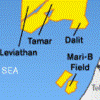
Israeli Leviathan field gas estimates up, oil down

JERUSALEM -- The Israeli partners in the offshore Leviathan natural gas and oil field Sunday revised the estimated amount of gas reserves in the field upwards to 20 trillion cubic feet from 16 trillion cubic feet.
The partners also revised downwards the potential oil reserves to 600 million barrels from 3 billion. The revisions are due to new government requirements for how energy companies estimate the amount of potential oil and gas reserves.
Leviathan, also partly owned by Noble Energy Inc. (NBL), is expected to begin producing natural gas by 2016. It is one of several natural gas reserves to have been discovered offshore Israel in recent years. The other large reserve, Tamar, is expected to begin production later this year.
Noble Energy owns 39.66% of Leviathan, and Delek Group Ltd. (DLEKG.TV) units Avner Oil Exploration LP and Delek Drilling each own 22.67%. Ratio Oil Exploration LP (RATI.L.TV) owns 15%.

Update: Rig partially collapses as Chevron continues search for survivors offshore Nigeria

SAN RAMON, Calif.-- Chevron Corporation said that an extensive search and rescue effort continues for two contractors who remain missing after yesterday s fire aboard the K.S. Endeavor, a drilling rig offshore Nigeria operated by FODE Drilling Nigeria Limited. While Chevron s highest priority remains the rescue of the missing contractors, the company continues to devote the necessary resources to resolve the rig incident in a responsible and timely manner.
As previously reported, the K.S. Endeavor was drilling a natural gas exploration well for Chevron Nigeria Limited (CNL). The well is located in the Funiwa Field approximately six miles (10 kilometers) offshore and in approximately 40 feet (12 meters) of water.
Chevron reports that 152 workers on the rig and an associated barge were safely evacuated. They are now onshore and have been given medical examinations. Two remain hospitalized due to minor burns, while others are being held for further observation. .
While a full investigation is still underway, Chevron said initial indications point to the possible failure of surface equipment during drilling operations that led to a loss of well control. The well continues to burn and the rig has partially collapsed. At this time, the company cannot estimate how long the fire will continue.
Chevron has contracted with and is mobilizing the Transocean rig Baltic to commence drilling a relief well. Chevron said the time required to complete the relief well is uncertain, but could extend for some period. Chevron is deploying additional drilling experts and well control specialists to Nigeria to assist with well control efforts and the relief drilling process.
A small sheen is visible in close proximity to the well, which the company continues to evaluate. The sheen is estimated at approximately 13 barrels. Production from Chevron s North Apoi platform remains shut in since it is situated in close proximity to the incident. Total production from the platform was approximately 2,000 barrels per day.
CNL owns a 40 percent interest in the well and the Nigerian National Petroleum Corporation has a 60 percent interest.